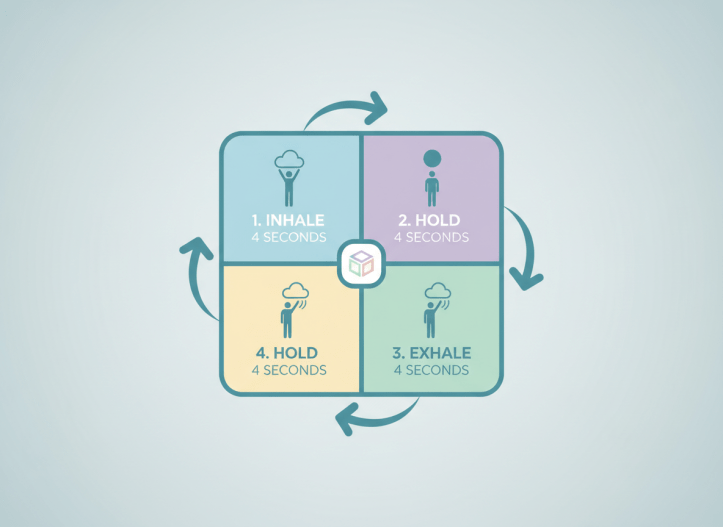
I first learned the box-breathing meditation technique when I was in Navy boot camp. Our instructors taught it as part of the Warrior Toughness training, and they claimed that high-performing operatives such as the Navy Seals use it to bring calm and focus in times of intense stress.
Box-breathing is a meditation technique that is easy to perform, and it provides numerous benefits.
Nervous System Regulation: The sympathetic nervous system is what puts the body in ‘fight or flight’ mode. It increases your heart rate and pumps your blood with adrenaline to help you respond to threats. You may not be running from tigers or fighting to protect your village from invaders, but whatever your brain views as a threat will create this response.
Fortunately, in modern society the threats of tigers and invading forces is not something we have to worry about, but an environmental threat could mean many things. It could be bills that you’re worried about, or that fight you had with your significant other, or maybe deadlines at work that are hanging over your head. Whatever it may be, the stress response activates the sympathetic nervous system, and we start feeling overwhelmed or anxious.
When you’re constantly stressed out and your heart rate is sky-rocketing, you don’t make very good decisions. You don’t respond well to additional stressors, and your body seems to be revolting against you. Your breathing becomes shallow and rapid, and you may not be conscious of it, but that breathing pattern influences your mental state, and not in a good way. Continue like this for long enough and you could be in real trouble.
So how do we combat it? Well, if the sympathetic nervous system can induce a stressed mental state by high-jacking your breathing, then using the Principle of Correspondence, we can infer that there must also be a breathing rhythm that can be used to induce a calm state of mind. Well, that’s box-breathing.
Box-breathing activates the opposite response in which the parasympathetic nervous system, the ‘rest and digest’ part of the nervous system, slows your heart rate and lowers the stress hormone cortisol.
By taking control of your breathing, you take control of your body’s automatic responses to your environment. You can regulate your nervous system by controlling your breath, one of the only sympathetic functions that we can take manual control of. By slowing your breath, you slow down all of the other bodily functions that are usually spun up whenever the sympathetic nervous system takes over.
Reduce Stress and Anxiety: By taking control of your breathing and slowing it down as discussed above, you lower your heart rate and aid the body in reducing cortisol. It may take a while to slow your heart rate, but after a few minutes of persistent effort, you will feel your body respond and begin to feel calmer.
I may not be a doctor or a psychologist, but I think that many people who suffer from constant anxiety are simply experiencing their body’s response to stress. Their nervous system goes into fight or flight and they start thinking stressful thoughts because their body is stressed out, and they create a vicious cycle of stress and stress response.
Before jumping to extreme solutions, I recommend going to the simplest solution there is, which is taking control of your stress response, and it starts with taking control of your breathing with box-breathing.
Think about it. If Navy Seals, who arguably have one of the most stressful jobs there is, use box-breathing to help them get through the high-intensity situations, then there must be something to it. Highly effective combat teams don’t use ineffective techniques.
Improve Your Focus: Counting your breaths and directing your mental energy to pay attention to your breathing means that the mind isn’t using that energy to entertain distracting and intrusive thoughts. This is one of the reasons that I love the Counting Meditation so much. You would be surprised by how distracted your mind is and by how little mental discipline you have over your attention when you try the counting meditation.
When you are having a stress response, its most likely because you are confronted with a problem. When dealing with problems it is far easier to come to an effective solution and to actually act upon the solution when your attention isn’t being blown any which way by whatever intrusive thoughts pop up into your head.
By practicing box-breathing, not only are you activating your parasympathetic nervous system and relaxing your body, you are also training your attention to stay focused on the task at hand. You are training your attention to be present, and that is an extremely powerful skill.
Imagine how effectively you could navigate the complexities of life if you could focus your attention exclusively on the task at hand and keep yourself calm in stressful situations. Practicing box-breathing can help you develop your focus and mental discipline.
Improve Your Sleep: We’ve all been there. Those late-night moments when you’ve been laying down but you just can’t seem to fall asleep. Your mind is racing and you can’t seem to relax enough to power down from the day. Your sympathetic nervous system is still on overdrive. What you need is for the parasympathetic nervous system to put you into ‘rest’ mode.
Close your eyes and practice box-breathing. Slow your heart down. Calm your racing mind.
It’s better to try box-breathing for a few minutes if it can help you fall asleep than to spend hours restlessly hoping to finally pass out. How do you expect to rest if your body and your mind are in a state of stress? You don’t need to scroll until your eyes are too tired to stay open. You don’t need to upgrade your bed or buy a special sleep mask, although those things may help. You just need to take command of your body with your breath.
Now, to the meat and potatoes.
How to Box-Breathe:
Sit or lay down in a comfortable position. Place one hand on your stomach and one hand on your chest.
Inhale for 4 seconds: Breathe in through the nose. Feel your stomach expand and then your chest.
Hold: Hold that breath for 4 seconds. Don’t strain yourself to hold it.
Exhale: Breathe out through the nose or the mouth. Feel your chest slowly fall down and then your stomach.
Hold: Hold that exhale for 4 seconds. Again, don’t strain yourself to hold it.
Rinse and repeat. If you lose your count, just start over with the next part of the rhythm.
Holding your hands over the stomach and chest isn’t necessary, but for beginners it is very helpful in training yourself to breathe properly because you are more aware of the rising and falling of your chest and abdomen. This will help you develop deep diaphragmatic breathing.
If you feel the need to shorten or lengthen the breaths, then do so without creating strain on your body to keep up with the pace. Make it feel as natural as possible. If you are pregnant or if you have high blood pressure, then consult your health professional before starting a breath-holding practice.
Like what you read? Subscribe to get the latest content!
Support the Eclectic Method and get cool merch in return! Click the banner or the link below to shop on the Eclectic Method store at stickermule.com and get a $10 credit! Search @theeclecticmethod and browse for unique designs and artwork created by the author.

https://www.stickermule.com/theeclecticmethod
Related Content:
 The Eclectic Method